
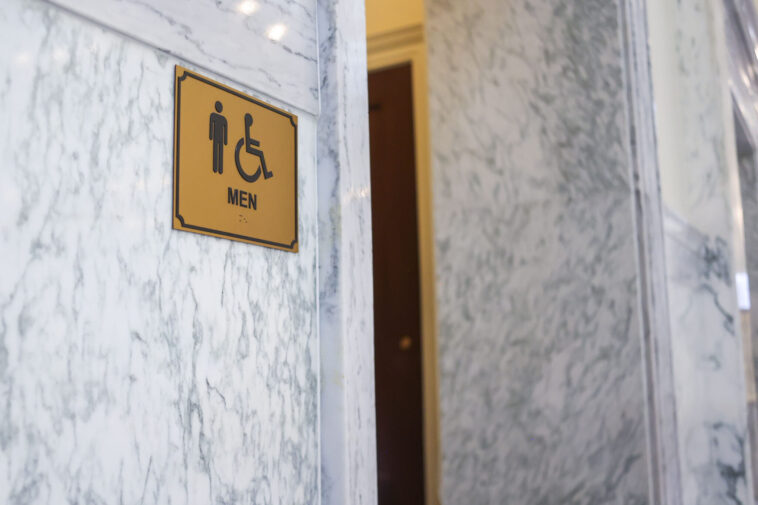
A federal judge in Idaho has temporarily blocked key parts of House Bill 752, which criminalized bathroom use for transgender people based on their gender identity. U.S. District Court Judge Amanda Brailsford made the ruling on June 16, 2026, after six transgender residents sued to challenge the law. This order protects transgender people’s limited use of public bathrooms without fear of arrest.
House Bill 752, passed earlier this year by the Idaho Legislature and signed by Governor Brad Little, makes it a misdemeanor for transgender people to use bathrooms that do not match their biological sex. The law threatened up to one year in prison for a first offense and felony charges with up to five years for repeat offenses. The rules applied to public facilities and private businesses open to the public. The law also bans transgender people from entering changing rooms that don’t match their biological sex; this part will take effect on July 1, 2026.
Judge Brailsford’s order blocks the criminal penalties related to bathroom access. She said the law’s wording was unclear and allowed for arbitrary and discriminatory enforcement by police. The judge pointed out that terms like “dire need” and “reasonably available” are vague and would require officers to decide on the spot. The lack of clear standards could lead to inconsistent application and potential violations of constitutional rights.
The order also protects transgender people who use single-user bathrooms or multi-user restrooms without a single-user option. She certified the case as a class action, meaning the law cannot be enforced against any transgender person in Idaho for bathroom use that differs from their sex at birth. The court has not yet ruled on other legal claims arguing House Bill 752 violates due process and equal protection. Judge Brailsford said those claims will be reviewed as the case moves forward.
The American Civil Liberties Union (ACLU) of Idaho praised the ruling, saying it lets transgender people use public bathrooms without fear of arrest. Paul Carlos Southwick, the ACLU of Idaho legal director, said the decision eases anxiety among transgender Idahoans about the law. Lawyers from the national ACLU, the law firm Munger, Tolles & Olson, Alturas Law Group PLLC, the ACLU of Idaho, and Lambda Legal represent the plaintiffs. Kell Olson of Lambda Legal said the Constitution protects against laws that force officers to make arbitrary enforcement decisions, especially with criminal penalties. Olson said this order offers immediate relief but the effort to overturn the entire law continues.
Idaho Attorney General Raúl Labrador, whose office defended House Bill 752, said they plan to appeal the order. Labrador said the law is needed to protect people in private, sex-specific spaces and denied the law was vague. He said his office will keep trying to enforce the law fully. He noted that the ban on entering changing rooms that do not match biological sex remains in effect.
Judge Brailsford recognized Idaho’s interest in protecting bodily privacy and vulnerable groups in restrooms. But she said Idaho can protect those interests without violating transgender people’s constitutional rights. Existing criminal laws against assault and related crimes already allow police to act against wrongdoing. The judge also doubted that House Bill 752 would improve public safety.
The court heard that determining biological sex for enforcement would be difficult. Police groups warned lawmakers that the law’s vagueness would put officers in tough spots. The Idaho Chiefs of Police Association said it is unclear how an officer would know if someone is in “dire need,” as the term is undefined. The attorney general’s office suggested DNA testing to verify biological sex, but the judge said DNA collection would need a warrant or consent, making it impossible to use in real-time.
House Bill 752 is part of continued Idaho legislation targeting transgender people. Other laws include a 2020 ban on transgender girls in school sports consistent with their gender identity, now before the U.S. Supreme Court, and a 2023 bathroom ban in public schools, recently enforced fully. A lawsuit against the school bathroom ban ended after a transgender student in the case died by suicide, as reported by local media.
This federal court decision is part of ongoing legal fights over transgender rights in Idaho. Judge Brailsford’s order keeps transgender individuals able to use bathrooms matching their gender identity without facing criminal charges for now. The case is active as courts review constitutional issues. The Idaho Attorney General’s office is preparing to challenge the ruling on appeal.